
UH Cancer Center's Body Composition Laboratory receives prestigious designation as IAEA Collaborating Centre
Now one of just eight IAEA Collaborating Centres in human health worldwide, shared resource laboratory will train Pacific Island health workers through 2030
August 27, 2026
The Body Composition Shared Resource Laboratory at the University of Hawaiʻi Cancer Center has received a prestigious designation as an International Atomic Energy Agency (IAEA) Collaborating Centre. The designation recognizes the lab as a center of excellence in assessing body composition, an important risk factor in cancer and other diseases. The laboratory at the UH Cancer Center in Kaka‘ako is now one of only eight IAEA Collaborating Centres in human health worldwide, and of those, the only one dedicated to nutrition.
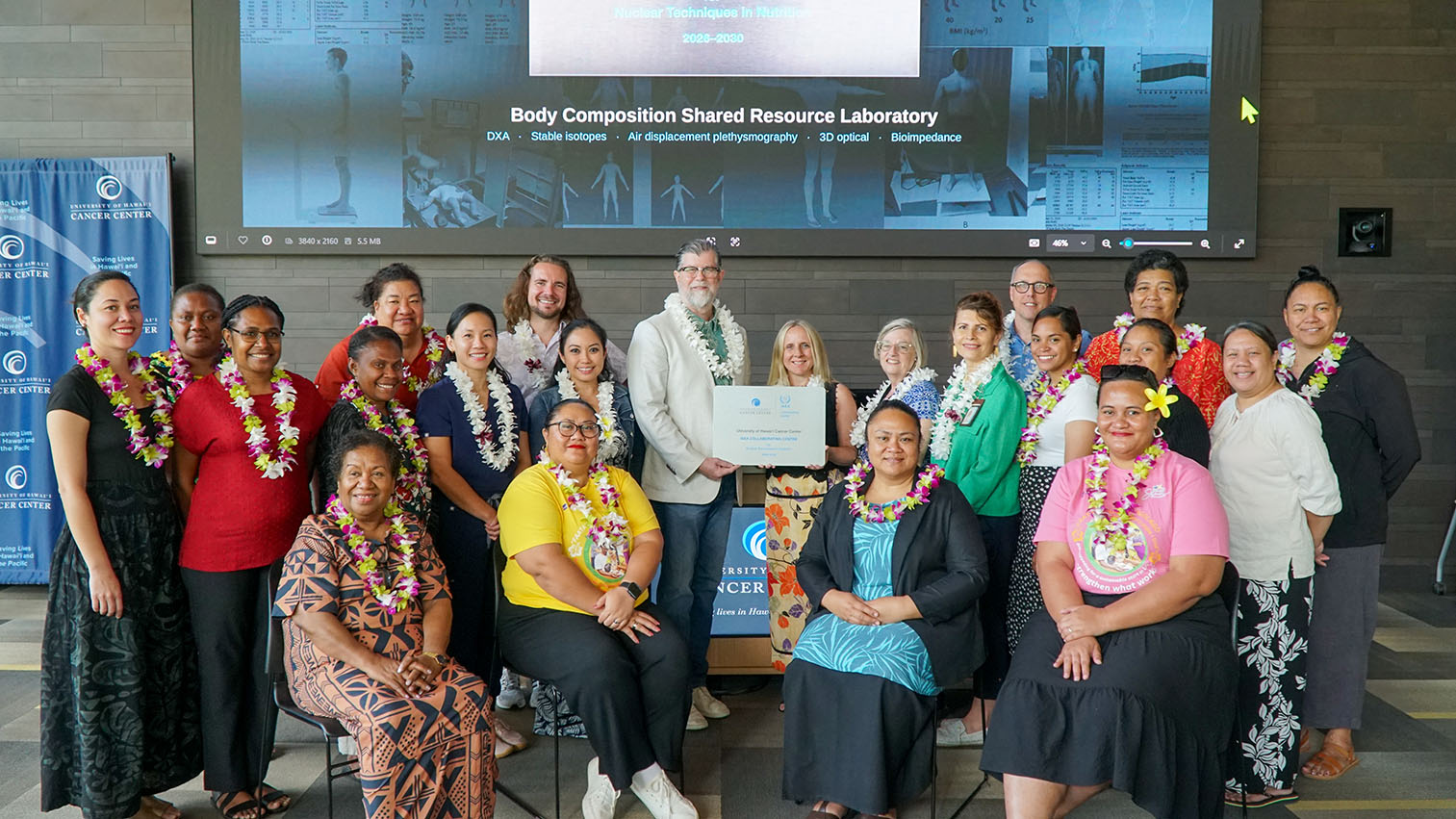
The UH Cancer Center’s Body Composition Lab becomes the world’s 8th IAEA Collaborating Centre in human health, and will train Pacific health workers through 2030.
The designation is much more than a label. It includes a joint work plan that will run through 2030 for the laboratory, which is led by laboratory Director and UH Cancer Center Chief Scientific Officer John Shepherd. Under the plan, the laboratory will work to standardize nuclear and radiological body composition assessment techniques, including DXA and deuterium dilution isotope methods; host technical workshops; conduct collaborative research projects; and deliver specialized clinical and technical training and resources for IAEA Member States. The need for such training is urgent because obesity is associated with approximately 20% of all cancers, Shepherd said.
“The designation of Dr. Shepherd’s lab as an IAEA Collaborating Centre places it within a small but elite international network and reaffirms the quality of research conducted at the UH Cancer Center,” said Chad B. Walton, interim vice president for research and innovation for the University of Hawaiʻi System. “It also helps to strengthen the distinct advantages that UH has in serving the needs of the Pacific region while expanding opportunities to contribute to — and benefit from — global collaboration, knowledge sharing, and advances in cancer research through the IAEA network.”
The IAEA is the world’s central intergovernmental forum for scientific and technical cooperation in the nuclear field. Working under the banner Atoms for Peace and Development, it promotes the safe, secure, and peaceful uses of nuclear science and technology, contributing to international peace and security and to the United Nations Sustainable Development Goals. The agency designates Collaborating Centres to conduct research, development and training in support of its work with Member States.
Plaque ceremony emphasizes human impact
The IAEA presented the official plaque at a ceremony on Wednesday, August 26, 2026, at the UH Cancer Center, 701 Ilalo St. Dr. Alexia Alford, a nutrition specialist at the IAEA, presented a plaque she carried from Vienna to recognize the laboratory team:
- Director Dr. Shepherd;
- Jonathan Bennett, PhD, researcher, and chair of the Body Composition section of the International Society for Clinical Densitometry;
- En Yong Liu, exercise physiologist and Body Composition Lab manager;
- Valerie Saiki, DXA technologist and clinical study coordinator; and
- Leila Kazemi, program manager.
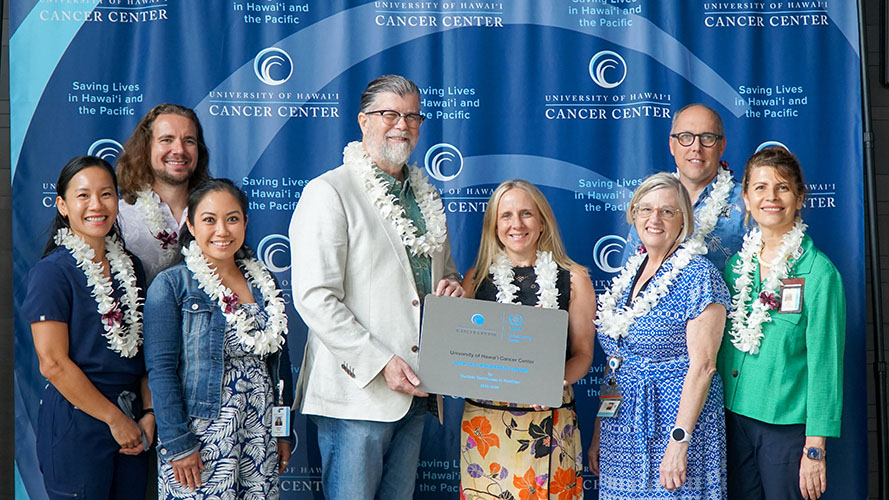
The designation was earned by the laboratory as a whole. Bennett established the stable isotope methods and the quality control behind them, and Liu manages the instruments and the reference standards they are calibrated against.
“It’s a great pleasure to be here today, representing the International Atomic Energy Agency, to formally recognize the University of Hawaiʻi Cancer Center as an IAEA Collaborating Center for Nutrition, with the Body Composition Laboratory at the heart of this collaboration,” Alford said.
“The agency works with institutions around the world that have already recognized scientific expertise and technical expertise, using these institutes to become partners and help support our work and program, and helping us extend the benefits of nuclear science and technology to all our Member States,” Alford continued. “This designation represents a partnership, recognizing expertise that already exists here, while reflecting a shared commitment to extending this expertise to not only the Pacific but the wider global community.”
Shepherd reflected on the human impact of the IAEA designation: “Body composition measurement is where nutrition science becomes quantitative. The countries that need this data most have the least access to the instruments that produce it. This designation lets us put those methods directly into the hands of health workers across the Pacific. The designation will allow us to guide the research and develop the resources to ensure body composition data informs nutrition policies and clinical guidelines across the world.”
“Our shared resources exist so that investigators across the UH Cancer Center have access to methods that would otherwise be out of reach in an isolated state,” added Lynne Wilkens, associate director of shared resources at the UH Cancer Center. “This designation says that one of those resources has the expertise to benefit not only our neighbours across the Pacific, but also the world.”
Fulfilling kuleana to Pacific nations
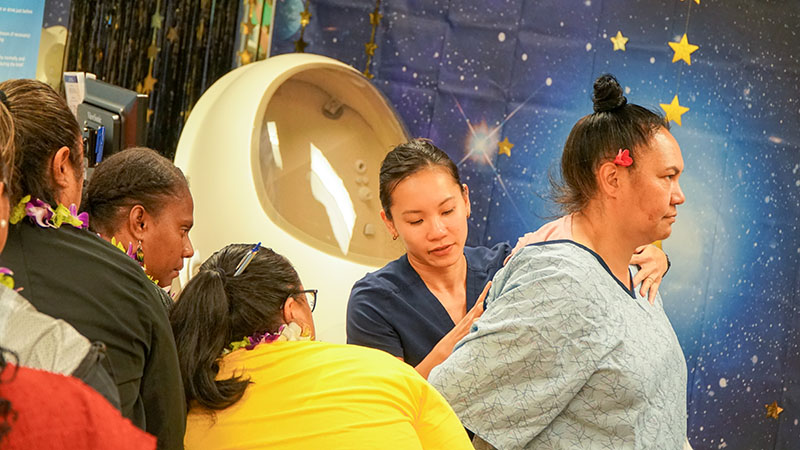
The plaque ceremony fittingly took place during the Body Composition Lab’s “Workshop on the Use of Isotopic Techniques for Nutrition Assessments,” an IAEA regional training course hosted August 24-28 at the UH Cancer Center. Delegates from Fiji, Papua New Guinea, Tonga, Samoa, Palau, Vanuatu, the Marshall Islands, and the Cook Islands are learning stable isotope methods for measuring body composition, including deuterium dilution dose preparation, saliva sampling, and sample analysis by Fourier Transform Infrared Spectroscopy, using infrared light to observe chemical properties. The delegates are learning also about anthropometry, the systematic measurement of the body; and receiving hands-on sessions on the laboratory’s DXA, BodPod, bioelectrical impedance, and 3D optical scanning systems. Hosting courses of this kind is a core obligation of an IAEA Collaborating Centre.
The IAEA designation aligns with the UH Cancer Center’s responsibility for its catchment area, which includes not just Hawaiʻi, but the U.S.-Affiliated Pacific Islands. As one of only 74 National Cancer Institute-designated cancer centers, the UH Cancer Center is in the top 4% of all cancer centers in the U.S., and has the largest catchment area of all the NCI-designated cancer centers; it spans approximately 7 million square miles, and includes more than 2 million people.
This announcement also was published in UH News.


